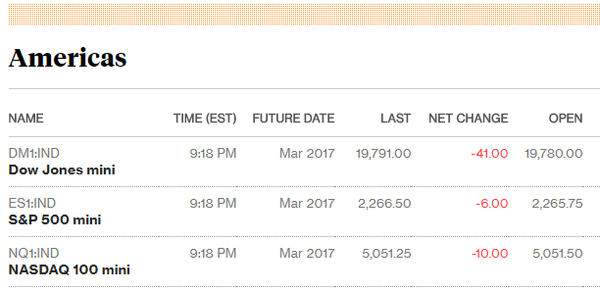
Good Evening MOJO Traders, Short week ahead and futures are red. I smell a correction coming.
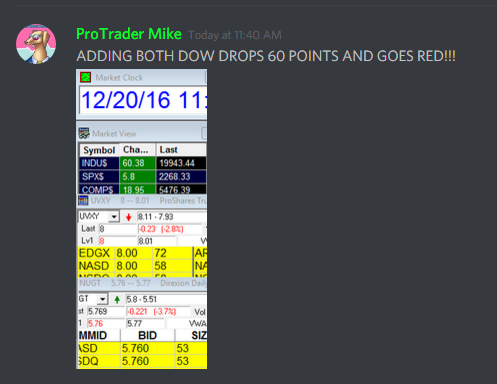
The Dow pushed 20,000 and I officially called the top at 19,943 see image. It has tested that several times and now it resides at 19,885 a pretty far stretch from The Land of 20,000! See that NUGT at $5.73 it doubled 100% from there, unreal huh!!
The futures are red now slightly bleeding now so let's see what the next 8 hours brings. By the time market opens at 9:30 am it will be different. Just like last few weeks of picks I will deliver this next weeks biggest winners to you as they present themselves.
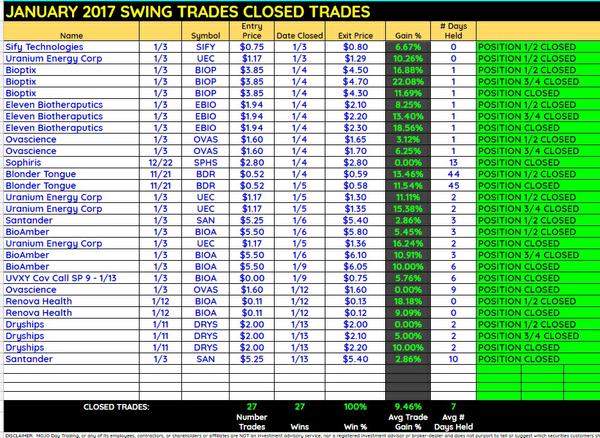
MOJO swing picks for the month of January like December have been great and these winners came to me when the market opened and presented itself and I would like to keep that
rhythm going.
P.S. Happy Valentines is approaching and MOJO has a lot of HEINZ to go around! Definition: A stock market correction is when the market falls 10 percent from its 52-week high. Wise investors welcome it. A pullback allows the market to consolidate before going toward higher highs. Each of the bull markets in the last 40 years has had a
correction. It's a natural part of the market cycle. Corrections can occur in any asset class.
What causes a correction? Typically, it's an event that creates panicked selling.
It can be
a gut-wrenching time. Many beginning investors will feel like joining the mad dash to the exits. Corrections are inevitable. When the stock market is going up, investors want to get in on the potential profits. It leads to irrational exuberance. That makes stock prices go well above their underlying value. A correction is when prices return to a sensible level.
Corrections:
The stock market typically has a correction several times a year. For example, between 1983 and 2011, more than half of all quarters had a correction. That averages out to 2.27 per year.
Fewer than 20 percent of all quarters experienced a bear market. That averages out to .72 times per year. (Source: "How Often Does the S&P Have Negative 10 Percent and 20 Percent Price Moves?" QVM Group LLC, March 19, 2013.)
Stock corrections are more frequent than crashes because they occur when the economy is still in the expansion phase. Why would the market correct even when economic data is upbeat? The stock market is a leading economic indicator. Investors look at future expected earnings to forecast corporate profits. They buy or sell stocks based on these projections. Sometimes
investors become too optimistic. They create a rally that exceeds current economic performance. That's when the market gets over-extended. Once that happens, any bit of doubtful news causes a correction.
As long as the future trend remains optimistic, the buying will resume. That leads to an even stronger bull
market rally. In other words, a stock market correction can help the stock market catch its breath and hit even higher peaks.
Most recessions occur with stock market declines of 30 percent or more. That's the contraction and trough phase of the business cycle. A crash can create them, but usually
larger economic events are the underlying cause. That's what makes a crash more devastating than a correction. Thank you, and keep it
profitable! DISCLAIMER: MOJO Day Trading, or any of its employees, contractors, or shareholders or affiliates are NOT an investment advisory service, nor a registered investment advisor or broker-dealer and does not purport to tell or suggest which securities customers should buy or sell for
themselves. The analysts and employees or affiliates of Company may hold positions in the stocks or industries discussed here. You understand and acknowledge that there is a very high degree of risk involved in trading securities. The Company, the authors, the publisher, and all affiliates of Company assume no responsibility or liability for your trading and investment results. Factual statements on the Company's website, or in its publications, are made as of the date stated and are subject to
change without notice. It should not be assumed that the methods, techniques, or indicators presented in these products will be profitable or that they will not result in losses. Past results of any individual trader or trading system published by Company are not indicative of future returns by that trader or system, and are not indicative of future returns which be realized by you. In addition, the indicators, strategies, columns, articles and all other features of Company's products
(collectively, the "Information") are provided for informational and educational purposes only and should not be construed as investment advice. Examples presented on the Company's website are for educational purposes only. Such picks, alerts, set-ups are not solicitations of any order to buy or sell. Accordingly, you should not rely solely on the information in making any investment. Rather, you should use the Information only as a starting point for doing additional independent research in
order to allow you to form your own opinion regarding investments. You should always check with your licensed financial advisor and tax advisor to determine the suitability of any investment.
Please note: Hypothetical computer simulated performance results are believed to
be accurately presented. However, they are not guaranteed as to accuracy or completeness and are subject to change without any notice. Hypothetical or simulated performance results have certain inherent limitations. Unlike an actual performance record, simulated results do not represent actual trading. Since, also, the trades have not actually been executed; the results may have been under or over compensated for the impact, if any, of certain market factors such as liquidity, slippage and
commissions. Simulated trading programs in general are also subject to the fact that they are designed with the benefit of hindsight. No representation is being made that any portfolio will, or is likely to achieve profits or losses similar to those shown. All investments and trades carry risks.
Copyright (c) MOJO Day Trading, LLC. 2012-2017. All Rights Reserved. No part of this newsletter, video, website or any of its contents may be reproduced, copied, modified or adapted, without the prior written consent of the author, unless otherwise indicated for stand-alone materials. |
|
|
|